
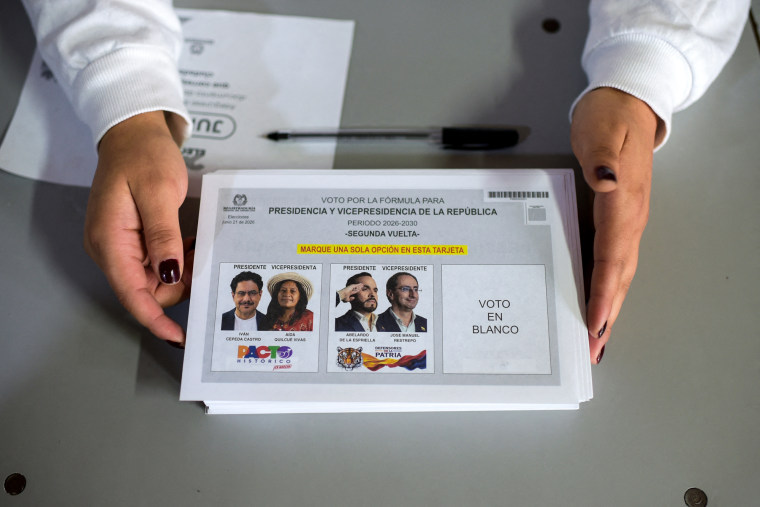
Bogota, Colombia — Colombia’s electorate faces a pivotal decision in the upcoming presidential runoff between two contrasting candidates: a progressive and a conservative outsider. Both are leveraging fears of renewed internal conflict to influence voters.
Abelardo de la Espriella, a businessman and lawyer, competes against Iván Cepeda, a lawmaker aligned with outgoing President Gustavo Petro’s political movement. Petro is Colombia’s first leftist leader. De la Espriella and Cepeda emerged victorious from a field of eleven candidates in the May 31 vote.
The candidates propose distinct strategies to avert the relentless violence Colombia experienced in past decades, including car bombings, kidnappings, disappearances, and forced displacements.
De la Espriella endorses a strong-handed approach, gaining backing from U.S. President Donald Trump. Cepeda intends to pursue Petro’s efforts, such as establishing dialogues with various illegal armed groups, despite previous failures.
Their plans extend to addressing Colombia’s faltering health system, rising public debt, and persistent corruption. A worker handles electoral materials at a polling station in Bogota during the runoff.
John Manrique, a lawyer in Bogota, expresses concern over political polarization and hopes for social consensus.
“What worries me is the division between us: two extreme sides, and the violence is concerning,” Manrique remarked as he walked his dog. “I hope people will accept the winner, regardless of the side, and strive for social consensus… Let’s not resort to fighting.”
In the initial round, Cepeda secured 41% of the vote, while de la Espriella achieved 44%. Petro cast doubts on the results, questioning Cepeda’s failure to win outright after leading the polls.
The election marks a decade since Colombia’s historic peace agreement with the Revolutionary Armed Forces of Colombia (FARC), aimed at ending prolonged conflicts between rebels and the government. However, violence has resurged as many rebel groups shift focus from ideology to drug trafficking.
Last year, authorities reported 14,780 homicides, the highest since 2015, due to clashes among illegal armed groups. Among the victims was conservative presidential hopeful Miguel Uribe. Extortions have increased, reaching 13,417 cases in 2025, doubling from 2015.
Over 41 million Colombians are eligible to vote. Raul Arboleda captures a voter in Bogota during the runoff.
De la Espriella, dubbed “The Tiger,” pledges to aggressively target criminals and establish ten mega-prisons, inspired by El Salvador’s President Nayib Bukele’s policies that have reduced homicide rates but raised human rights concerns.
Cepeda seeks to advance Petro’s criticized initiative of “total peace” through negotiations with guerrillas and gangs. The strategy commenced in 2022, seeing its first success Thursday with an armed group of 100 members surrendering weapons and initiating resettlement.
Colombian illegal groups comprise over 27,000 members. Yamile Guevara, a retired Bogota teacher, argues Petro’s strategy demands time given Colombia’s six-decade conflict. She addresses voters’ ongoing distrust of the left due to historical associations with rebel groups.
“The left has always been perceived negatively due to its harshness and the deaths it caused,” Guevara, a Cepeda supporter, stated. “It’s perplexing that people who’ve overlooked history fail to ponder carefully on their candidate choice.”
The runoff’s buildup comprised heightened verbal confrontations between candidates, fraud accusations, and allegations of vote-buying and intimidation.
Cepeda filed a complaint against de la Espriella with the Colombian Attorney General’s Office and the International Criminal Court, accusing ties to paramilitary groups—a claim de la Espriella denies.