
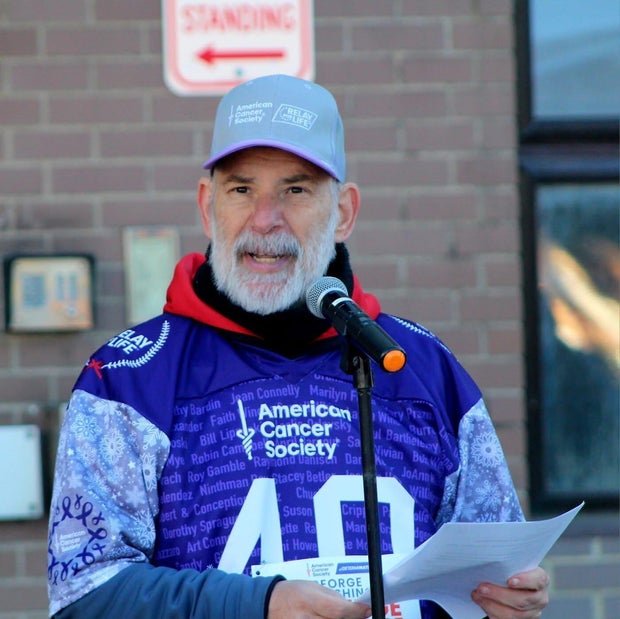
One ordinary day, Joe Gillette noticed he was seeing double from one eye during his morning commute. Initially, Gillette attributed this to a side effect of a recent COVID-19 infection. His doctor advised him to consult an eye specialist and undergo a brain scan.
The eye specialist discovered nerve damage in his right eye, leading to the double vision. Though this explanation seemed plausible, Gillette, who spent years volunteering with the American Cancer Society, opted for comprehensive testing. He understood the significance of a full medical workup.
“My wife was right next to me, and we’re reading it, it says ‘Cancer, tumor in the kidney, lung, brain and stomach,'” Gillette recalled. “It was the worst birthday present ever. I was devastated, to say the least.”
He learned of his Stage IV kidney cancer on his 57th birthday. Doctors found tumors not only in his kidneys but also in his brain, bones, lymph nodes, lungs, and pancreas. The cancer had silently spread, showing no symptoms until his vision problem.
Gillette expressed relief that the COVID-19 episode led to early intervention. “If it wasn’t for COVID, I wouldn’t have caught it,” he remarked, contemplating what waiting could have meant for his condition.
Dr. Martin Voss, Gillette’s oncologist at Memorial Sloan Kettering Cancer Center in New York, commenced aggressive treatment. The survival rate for Stage IV kidney cancer patients remains below 20% over five years, according to the American Cancer Society. Gillette underwent immunotherapy, radiation, and brain surgery. Recovery required a 10-week medically induced coma.
Upon awakening, Gillette was disoriented, unaware that months had passed. “You’ve been here for two and a half months,” a nurse informed him, leaving him shocked.
After physical and occupational therapy, Gillette regained strength. Further radiation therapy reduced his tumors. Two years of immunotherapy followed, which Gillette tolerated well with minimal side effects.
In April 2024, he had surgery to remove the original kidney tumor. Contrary to his fears, recovery was swift, and he left the hospital three days later.
Today, Gillette remains grateful for modern medical advancements. Dr. Alpa Patel from the American Cancer Society emphasized the importance of innovative treatments that didn’t exist a decade ago. “The cancer is very much under control and being monitored really well,” Patel noted.
Gillette’s journey isn’t solely about his health. Presently, he relishes significant family milestones and continues volunteering with the American Cancer Society. He highlights the support he’s received, saying, “I’m grateful every day, not for what happened to me, but to have had that support and gotten through it.”