
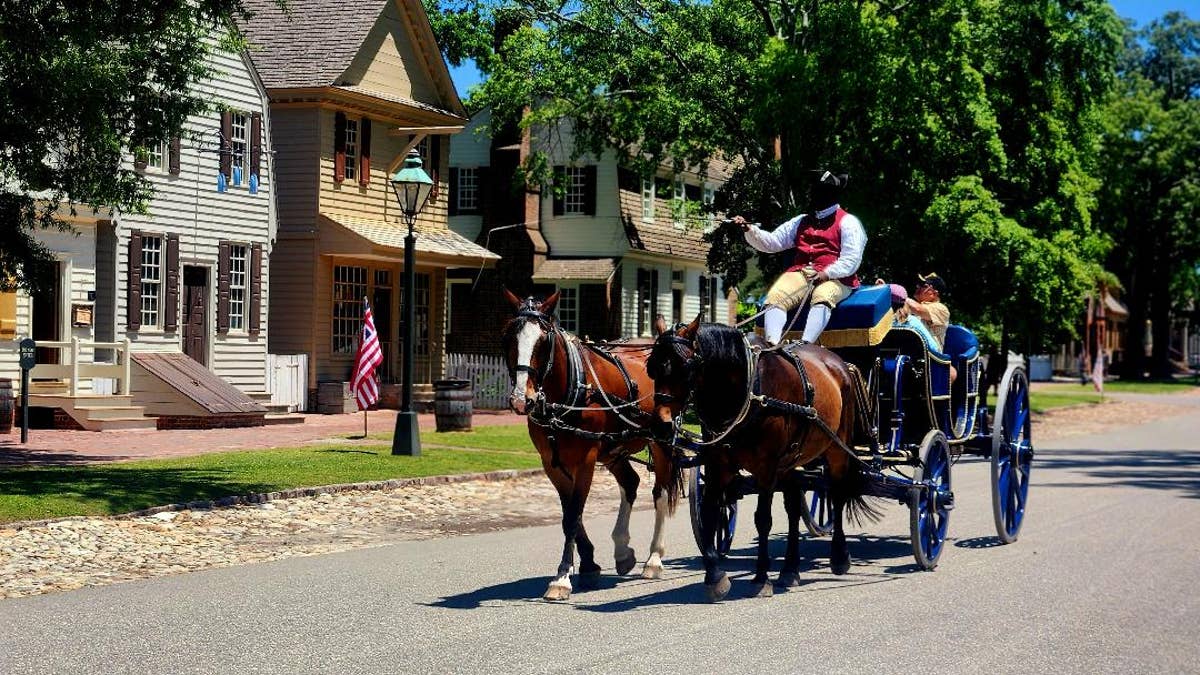
Colonial Williamsburg in Virginia, often referred to as ‘the birthplace of America,’ is gearing up to welcome large crowds this summer for America’s 250th celebrations. The highlight event will take place on the evening of July 4th, on the Courthouse Green, according to Robert Currie, director of entertainment, special events, and evening programs at Colonial Williamsburg.
Visitors frequently enjoy horse and carriage rides along the scenic Duke of Gloucester Street in this historic area. It is here that notable figures like George Washington, Thomas Jefferson, Patrick Henry, and George Mason were active during a time when Williamsburg thrived as a colonial town aspiring for independence from British rule. Today, the area serves as an ‘open-air museum’ for public enjoyment.
During Independence Day celebrations in Colonial Williamsburg, the Declaration of Independence is read from the Capitol’s balcony. Williamsburg was a central hub of early American social and political life. According to Colonial Williamsburg historian Peter Inker, the city once served as Virginia’s political capital, hosting debates that fueled the desire for independence.
“Families like the Randolphs and Carters held significant sway in colonial society and governance,” stated Inker.
In Williamsburg, influential political figures and ordinary residents alike are remembered as nation-builders. Notably, on June 12, 1776, the Fifth Virginia Convention adopted the Virginia Declaration of Rights, mainly drafted by George Mason. This document influenced the Declaration of Independence and the U.S. Bill of Rights, emphasizing inherent rights and the principle that power derives from the people.
However, the historical pursuit of ‘liberty for all’ in Williamsburg did not initially include everyone. A substantial part of the population were enslaved African Americans whose labor sustained the colonial system. Their stories are now central to Williamsburg’s historical interpretation, underscoring slavery’s realities and Black Americans’ contributions to founding the nation.
By the 20th century, the once-prosperous town had declined, but Rev. W.A.R. Goodwin sought to preserve the area as a living history museum. John D. Rockefeller Jr., a wealthy philanthropist, played a key role by quietly financing Williamsburg’s restoration in the 1920s.
Today, Colonial Williamsburg attracts visitors who explore its charming streets, interact with reenactors, and enjoy a historically immersive experience. The Pulaski Club, founded in 1779, reflects Williamsburg’s long tradition of civic and social associations.
In preparation for the U.S. semi-quincentennial, Colonial Williamsburg plans to celebrate with grandeur. Highlights will include a reading of the Declaration of Independence and a fireworks and drone show. The event will feature historic programming, military reenactments, and interactions with costumed interpreters. Guests can enjoy free admission on July 4th to all sites and museums.