
NASA is set to reveal the team of four astronauts scheduled for the next mission in the Artemis moon program. This announcement will take place at the Johnson Space Center in Houston and marks the beginning of extensive mission-specific training for the Artemis III crew.
Next year, this crew is expected to embark on a crucial mission to Earth orbit. They will focus on testing rendezvous and docking procedures with moon landers developed by SpaceX and Blue Origin. These procedures are vital milestones for the U.S. to achieve its goal of sending astronauts back to the moon for a landing in 2028.
The Objectives of the Artemis III Mission
The Artemis III team faces the challenge of mastering operations necessary for a subsequent lunar orbit flight. Their mission mirrors NASA’s Apollo 9 operation, which took place in March 1969. During that mission, astronauts tested the lunar excursion module in Earth orbit after the successful Apollo 8 orbital mission at the end of 1968.
The mission will launch in an Orion capsule atop NASA’s Space Launch System rocket. The strategies and techniques honed during this mission are essential steps toward the United States’ first moon landing in nearly 55 years.
NASA’s Moon Landing Strategy
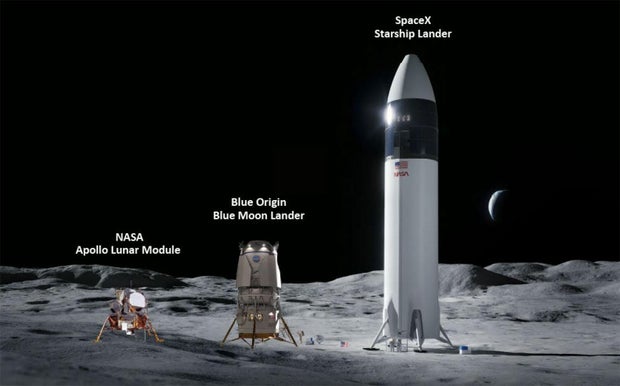
Artemis III represents the sole test flight before NASA attempts a landing in 2028. By then, either SpaceX or Blue Origin must have completed a successful unpiloted moon landing. An artist’s depiction illustrates NASA’s Apollo moon lander, Blue Moon’s Mark II lander, and SpaceX’s Starship lander, drawn to scale on the lunar surface.
The Artemis III crew is being announced as Blue Origin navigates recovery efforts following a major launch pad explosion on May 28. This incident destroyed a New Glenn rocket, required for deploying the company’s Blue Moon Mark II lander into orbit. Despite the significant damage to its Cape Canaveral launch pad, the Jeff Bezos-owned company aims to resume flight by year-end. Nevertheless, this setback affects the New Glenn launch timetable for the Blue Moon Mark I, an uncrewed lunar cargo ship.
Whether the New Glenn rocket and Cape Canaveral’s pad 36 will be ready to launch a Mark II lander for Artemis III is uncertain. Meanwhile, SpaceX grapples with challenges in perfecting the Super Heavy-Starship rocket needed for their lander. The timeline for SpaceX’s lander to be prepared for an orbital test flight is unclear, but NASA is advancing its plans for the Artemis III mission.
Future Mission Plans and Space Innovations
If a single lander is operational, the mission will move forward. Alternatively, if neither is ready, NASA may devise a different mission to maintain program momentum. The Artemis initiative aims to return astronauts to the moon by the end of 2028, with an eye on competing with China, which is racing to send its own astronauts to the moon by decade’s end.
Despite the success of 12 moon landings during the Cold War’s space race, NASA aims to establish a permanent presence on the moon through the Artemis program. The agency intends to solidify its status as the world leader in space exploration.
Alongside the Artemis IV and V missions, NASA is planning to deploy a series of robotic landers and lunar satellites. Eventually, two astronaut landings per year will set the stage for building a moon base near the lunar south pole by 2029-2030.
The south polar region holds promise due to its permanently shadowed craters, which are believed to contain comet-borne ice deposits. Such deposits can be tapped as a source of water, air, and rocket fuel. Establishing habitats and solar and nuclear power stations will allow astronaut crews to live and work on the moon for extended periods, similar to the International Space Station’s long-standing operations.
However, multiple hurdles threaten the Artemis schedule, including rocket and lander readiness, which may postpone the Artemis III mission to 2028 and subsequent landings even further. The necessity for additional test flights between Artemis III and a moon landing is still an open question.