
Operation Midway Blitz: The Arrest and Release of Eriksen Ventura Romero
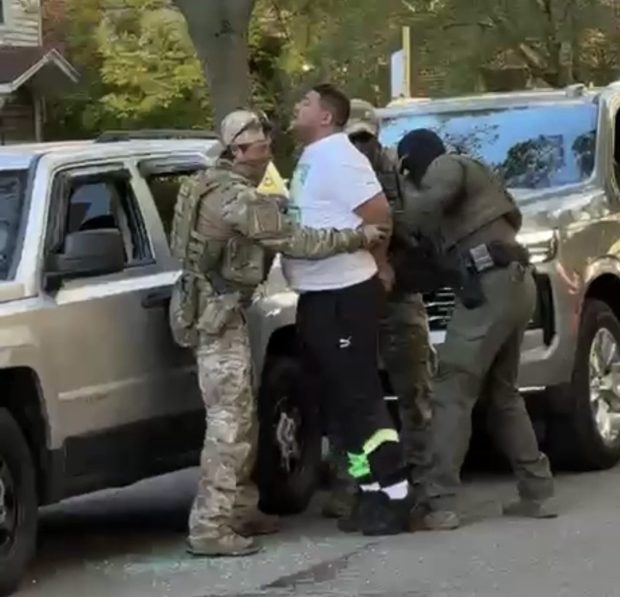
In October 2025, Eriksen Ventura Romero, a Venezuelan national involved in immigration proceedings, faced an unexpected encounter after dropping off his pregnant wife at a clinic in West Town, Chicago. Federal court records reveal he was surround by eight heavily armed Border Patrol agents outside Erie Family Health Center. Ventura Romero, in distress, attempted to inform his wife of the situation via FaceTime as agents declared his illegal presence and threatened to break his vehicle’s window.
The body-worn camera footage showed an agent warning Ventura Romero that his window would be smashed if he didn’t exit the vehicle. Ventura Romero pleaded in Spanish, “My wife is there, how can I leave her alone? She does not have anyone else here, it is just me.” Within the next 90 seconds, agents forcibly removed him as part of Operation Midway Blitz, an immigration enforcement operation under the Trump administration.
The window was broken, and agents dragged Ventura Romero from his car amid protests from bystanders. He was handcuffed, tased, and placed in an unmarked vehicle before being taken away.
Ventura Romero’s arrest marked the beginning of a prolonged detainment spanning seven months across several jails. He missed his son’s birth and endured removal proceedings pressure. Nevertheless, a federal judge recently ruled the arrest as a violation of a longstanding consent decree, ordering his release without bond restrictions.
Legal Proceedings and Judicial Ruling
U.S. District Judge Jeffrey Cummings determined the arrest lacked probable cause and was warrantless. Evidence showed Ventura Romero, with no criminal history, posed no immediate escape risk. Ventura Romero entered the U.S. in October 2023 and was paroled pending an asylum application. The ruling mandated his release from a detention center in Texas.
For his family, the court’s decision overturned an unwarranted arrest that kept him away from his pregnant wife and newborn child. The arrest reverberated far beyond Ventura Romero, impacting witnesses and local clinic staff. Video footage of the arrest taken from inside the clinic depicted agents surrounding his car with rifles. Witnesses expressed shock and concern for the clinic staff’s safety.
Legal Representation and Broader Implications
Attorney Jackie Garcia represented Ventura Romero after being contacted by his family through another former detainee’s connection. Many of Garcia’s clients have lawfully entered the U.S., complied with immigration processes, but faced detention similar to Ventura Romero’s case. This often results in family separations, complicating asylum cases, causing financial hardship, and requiring reliance on community resources.
The financial and emotional toll of Ventura Romero’s detention was substantial. His wife depended on church support during her high-risk pregnancy and son’s birth, living apart from her husband and enduring stress affecting their baby’s health.
Community Impact
The arrest drew attention from community members and rapid-response volunteers who witnessed the event at Erie Family Health Center. Roberto Mendez, an employee at Erie House, followed protocols for recording and reporting enforcement activity, capturing moments of Ventura Romero’s removal. Ventura Romero’s wife was visibly distressed inside the clinic, watching her husband’s detainment unfold.
Border Patrol reports described Ventura Romero as resistant and attempting to flee, which contradicted video evidence indicating struggles without attempts to escape. The Department of Justice argued Ventura Romero posed a flight risk, but the judge noted the unjust nature of suspecting him based solely on his presence in a parked car.
The consent decree prohibits warrantless arrests unless probable cause and flight risk are evident. Efforts have progressed within immigration rights circles to identify and rectify violations surrounding arrests like Ventura Romero’s. The court ordered release of many detainees, raising questions about detentions under Operation Midway Blitz conditions.
Community support and practical solutions emerged following Ventura Romero’s case at Erie Family Health Center. Families initially fearful of seeking services transitioned to virtual options, with organizations ensuring safety protocols for visiting patients. Community volunteers facilitated safe access to healthcare for those apprehensive of immigration enforcement.
Statements from Erie Family Center’s executive director, Cristina De La Rosa, expressed gratitude for judicial acknowledgment of Ventura Romero’s case, emphasizing justice and dignity.