
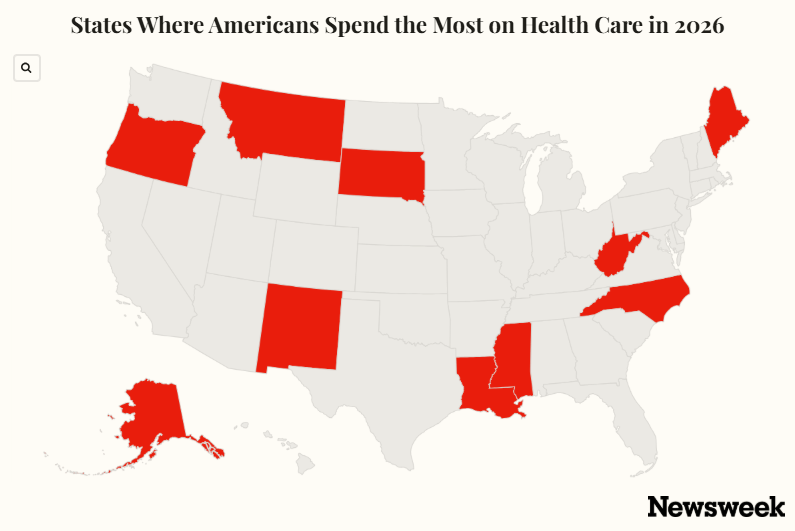
Americans are experiencing an increasing financial strain due to rising health care costs over the past two decades. A report from WalletHub indicates that health care expenses consume a significant portion of household income in some states, with residents in certain areas spending over 10% of their earnings on medical care. In contrast, people in the least expensive states spend about half that percentage.
Across the country, average annual out-of-pocket health care expenses have risen from $811 to $1,514 in the last 20 years. This increase outpaces inflation, adding pressure to household budgets. Many Americans face difficult financial decisions, with some delaying or foregoing necessary care. Even in states with lower costs, incomes often fail to cover essential expenses, especially with inflation affecting housing and food costs.
Understanding WalletHub’s Health Care Spending Ranking
The WalletHub report analyzed spending across all 50 states, focusing on how much of the median household income goes to vital medical services and medications. The top states where residents spend the most on health care include:
- Alaska – 10.08%
- Oregon – 9.32%
- Maine – 9.30%
- Mississippi – 9.18%
- West Virginia – 9.14%
- New Mexico – 9.07%
- North Carolina – 8.78%
- Montana – 8.62%
- South Dakota – 8.60%
- Louisiana – 8.13%
States with the least income spent on health care include:
- Utah – 5.11%
- Virginia – 5.62%
- California – 5.64%
- New Jersey – 5.81%
- Nevada – 5.87%
Factors Influencing Health Care Costs
High health care spending often reflects steep medical costs rather than lower incomes. Even in states with cheaper health care, residents’ earnings may not meet expenses. Chip Lupo, a WalletHub writer, explains that sharp increases in health care costs have hindered access to essential care. Inflation has affected all aspects of Americans’ budgets, not only medical expenses.
Case Studies: High Health Care Cost States
Alaska stands out, with residents devoting over 10% of their income to health care. The higher spending is attributed to costly doctor visits and medications. Although Alaska’s median income ranks high, expensive care pushes overall spending above other states.
For Oregon, the 9.3% of income spent on health care is largely due to expensive services like doctor and optometrist visits. High prices impact costs more than low wages.
Maine, third in high spending, combines high medical prices with below-average household earnings, elevating the percentage of income spent on health care to 9.3%.
Calculating Health Care Rank
The WalletHub report assessed state medical spending through five components:
- Doctor visits
- Dentist visits
- Optometrist visits
- Prescription costs for ibuprofen
- Prescription costs for insulin glargine
Costs were compared to median household incomes for each state to gauge the financial burden. Data were collected from the Council for Community and Economic Research and the U.S. Census Bureau as of April 30. Michael Ryan, a finance expert, notes the hidden reality for families paying a quarter or more of their income on health care, highlighting those not reflected in average percentages.
Strategies to Mitigate Health Care Costs
While geography influences health care expenses, Americans can take steps to manage costs. Maintaining health insurance and utilizing covered preventive services can save money long-term. Building an emergency fund and using tax-advantaged health savings accounts can also help reduce expenses.
Financial literacy instructor Alex Beene notes that declining healthcare facilities in many states reduce competition. Ensuring insurance doesn’t always capture all factors affecting costs, which need consideration when budgeting for medical expenses.
Future of Health Care Affordability
Regional disparities in health care costs may become a key policy issue as expenses grow. Without changes in pricing, insurance, or incomes, more Americans in high-cost states may see increased income shares directed to care. Kevin Thompson, CEO of 9i Capital Group, emphasizes that health care inflation exceeds insurance premiums, affecting the entire system and ultimately impacting consumers.